Concordance Rings
Where two or three roots meet across the whole Quran.
What it shows
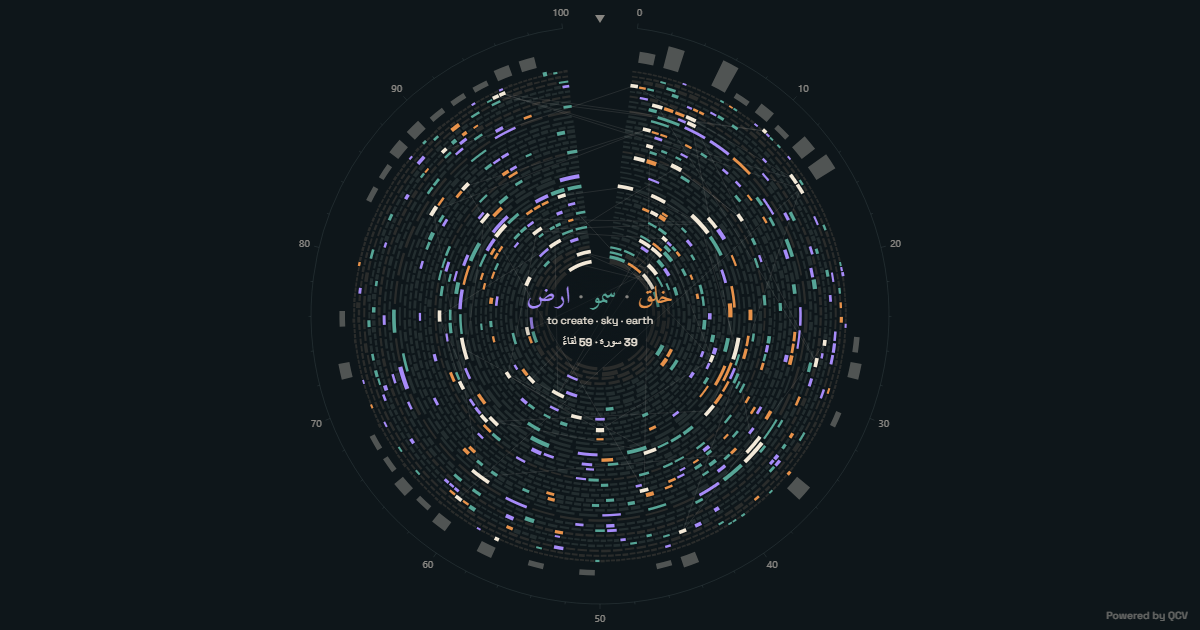
Every surah is a ring and every ayah a tick on it. A tick lights in a root's colour where that root occurs, and becomes a meeting where every chosen root shares the same ayah.
How to read it
- Each ring is one surah, its number in the gap at the top. By default the lowest-numbered surah is the outer ring and higher ones step inward; “Ring order” sorts them other ways.
- A ring starts at the top, just right of the ▼, and runs clockwise. The outer scale, 0 to 100, is how far through its surah an ayah is. Every surah is stretched to the same circle, so 50 is the middle ayah of a short surah and of a long one alike.
- Each tick is one ayah, taller the more words it has. It lights in a root's colour where that root occurs, and in the meeting colour where every chosen root shares the ayah.
- Threads join each meeting to the nearest meeting on the next ring out, so meetings at the same point line up. The bars just inside the scale count the meetings at each point, across every ring.
- The centre names the roots and counts the surahs where they meet, and the meetings in all.
- With no ring open, the details panel counts how far each root reaches: its words, and the ayahs and surahs that hold it. With two or three roots it adds how many ayahs and surahs they share, and with three, each pair's own meetings.
- Positions count ayahs, not words. A meeting means the roots share an ayah, not that the ayah links them in meaning: open it and read.
What it is for
Frequency tables say how often a root occurs. This says where — and, for two or three roots at once, where they come together.